
For AAC users and families
Getting started
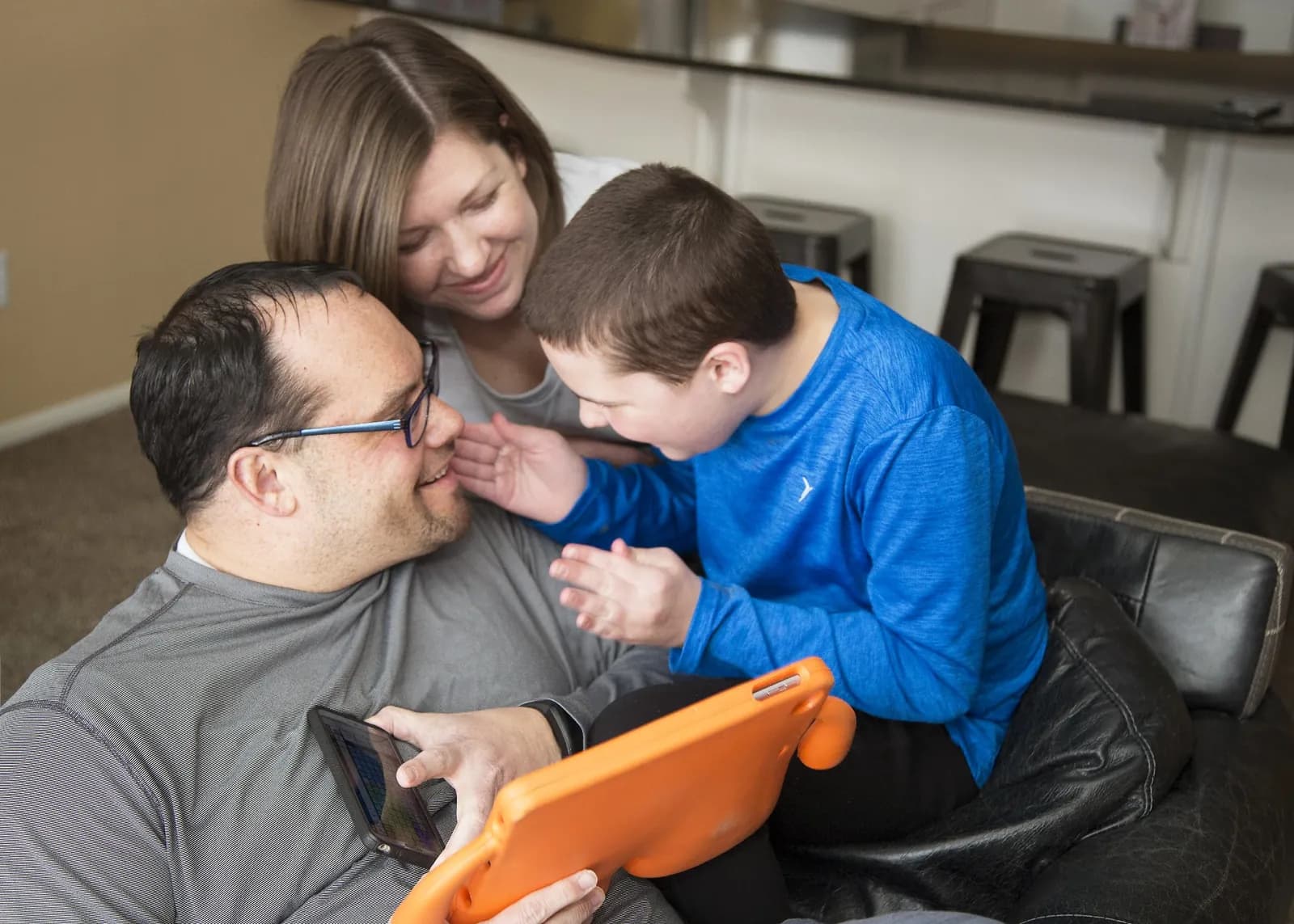
Getting started with a new AAC system can be overwhelming; there is a lot for conversation partners at home to learn. It helps to acquaint yourself with the device and its layout before beginning to model for your child: knowing where frequently used buttons are, and knowing how to use the search function. Once you know the search function and some of the more frequently used boards, probably things like food, toys and clothing that you use and talk about every day, the best way to get started is simply to start. Although we want to model confidently, modelling self-reflection and correction skills can also be very valuable to early AAC users.
Try to pace yourself. Attempting to model AAC during every activity you do can be exhausting, overwhelming, and lead to burnout. Start small: choose one activity a day at the beginning. Eating a snack, playing with toys, or part of a bedtime routine are often good places to start. As you become more comfortable modelling AAC, add another activity, then another, until you are using AAC consistently throughout the day.
You do not need to have perfect Irish to use Geabaire at home. Research shows that children with significant communication challenges can become bilingual, and that their language skills do not suffer when they are exposed to more than one language. Do not hesitate to use both Irish and English if that is what you are most comfortable with. If you are eating dinner, you can open the food page and say something like, "Look at what you have on your plate! Chicken, potatoes, and broccoli," and use the device to model sicín, práta, brocailí. You might say the foods in both Irish and English as well.
How to model at home
The ideas below show ways to integrate modelling into daily activities at home. You do not need to do exactly what they say; they are just ideas to get you started. Make things simpler or more complex according to your child's needs. Focus on preferred and low-stress activities, or set routines like mealtimes, bedtime, or getting ready for school, and work modelling into your day gradually.
Even if you have very little Irish, you can still use Geabaire to model. Start with basics: if you have the book Brown Bear, Brown Bear, What Do You See?, you can read it in English and use Geabaire to model colours or animals.
A key point to remember is to prioritise connection over device use. It is very important for your child to use their AAC and have communication models at home, but it is even more important that you connect with your child. If the device is getting in the way of that, designate a time to use it every day, maybe at a meal or play time, but do not let it become a strain on your relationship with your child.
| Communicative function | Examples |
|---|---|
| Requesting a preferred item |
|
| Directing another's actions |
|
| Requesting help |
|
| Commenting |
|
| Routines |
|
AAC access at home
It is important for your child to have access to their AAC device as much as possible at home as well as at school. Try to remember to keep it charged, and only use it for communication; it should not be used for entertainment.
It can be tempting to take the device from your child if they are using it to repeat the same word over and over, or pushing random buttons. Do your best to redirect them, but let them keep the device. Pushing the same button, or random ones, is often like babbling for children who are learning language: your child is exploring what they can use their device to say.
Using AAC across environments
Once you are able to use your child's AAC fairly proficiently, and feel comfortable using it in a variety of routines at home, it is important to start using it outside your home as well. You can do this in incremental steps too. Very little involving AAC is one-size-fits-all, so adjust the ideas below to what works for you and your family as you gradually work up to modelling AAC throughout the entire day.
You might begin by taking the AAC to the playground, provided you have a sturdy case for it, and using it to model things like location words. You could model "up" and say "Go up the ladder!", then model "down" and say "Go down the slide!" Again, you can use Geabaire in Irish and speak English in the same interaction. Using AAC at the playground gives your child an opportunity to see AAC used outside their school and home, and can help ease you into using the device in social situations.
You might also bring the device to the grocery store, where you can model the items from your shopping list and ask your child what they would like to get. This gives them an opportunity to use their device to request items and communicate their preferences, and to see you use the device.
A social context to start with could be a playdate with a familiar friend. It helps to come up with an explanation for children of what your child's AAC system is, how they use it, and why it is important. Children in particular will most likely be interested in the screen, so it is important for them to know that your child needs their device to communicate and that it is not a toy. Tailor the explanation to your situation, but as an example, you could say something like this:
"Sometimes [your child's name] has a hard time finding their words, so they use this iPad to talk. It's called an AAC device. They only use it for talking, not for games or videos, and it's really important that they always can reach it. When they use it, we listen to them just like we would if they used their voice. They really like to swing; do you want to swing together?"
Talking with adults, you can give a little more information about the device, how to use it, and why it is so important for your child to have access to it. You do not have to give other adults a whole lesson on AAC; you can just have conversations about your child's communication and what you are doing to support them as they learn. If you have family and friends you see often, you might invite them to use your child's device to model as well, if you and they are comfortable doing so.
As you and your child become more comfortable using the device, you may want to start interacting with less familiar people. If you have to ask a clerk at a shop for help, you could use both the device and spoken language to do so. As your child becomes more comfortable, you can encourage them to make requests at the library, the shops, or anywhere else. This may feel uncomfortable at first, but it is important to encourage children to communicate with less familiar adults and peers, with appropriate support from their caregivers, as they grow.
You may also want to personalise the device for your child: make preferred topics readily available, put the names of their family members and friends on the device, and ensure that vocabulary for frequently visited places is included.
Give yourself and your child time to learn and to become comfortable using AAC in public. While it may be temporarily uncomfortable, it should not cause consistent stress to you or your child. If you feel that it is, it is okay to take a break and try again later. Becoming comfortable using AAC is a process, and it can take a while to feel ready to use it in novel situations.