Using AAC
What is AAC?
AAC stands for augmentative and alternative communication. There are several different types of AAC: high-tech, like a speech-generating device; mid-tech, like a button or set of buttons with pre-recorded words and phrases; and light-tech, like a letter board, picture cards, or a printed communication board. AAC can also be gestural, or unaided. Aided AAC refers to communication that requires additional tools, like an iPad, printed pictures, or even paper and pencil. Most AAC users use a combination of these types of AAC to communicate.
What is modelling?
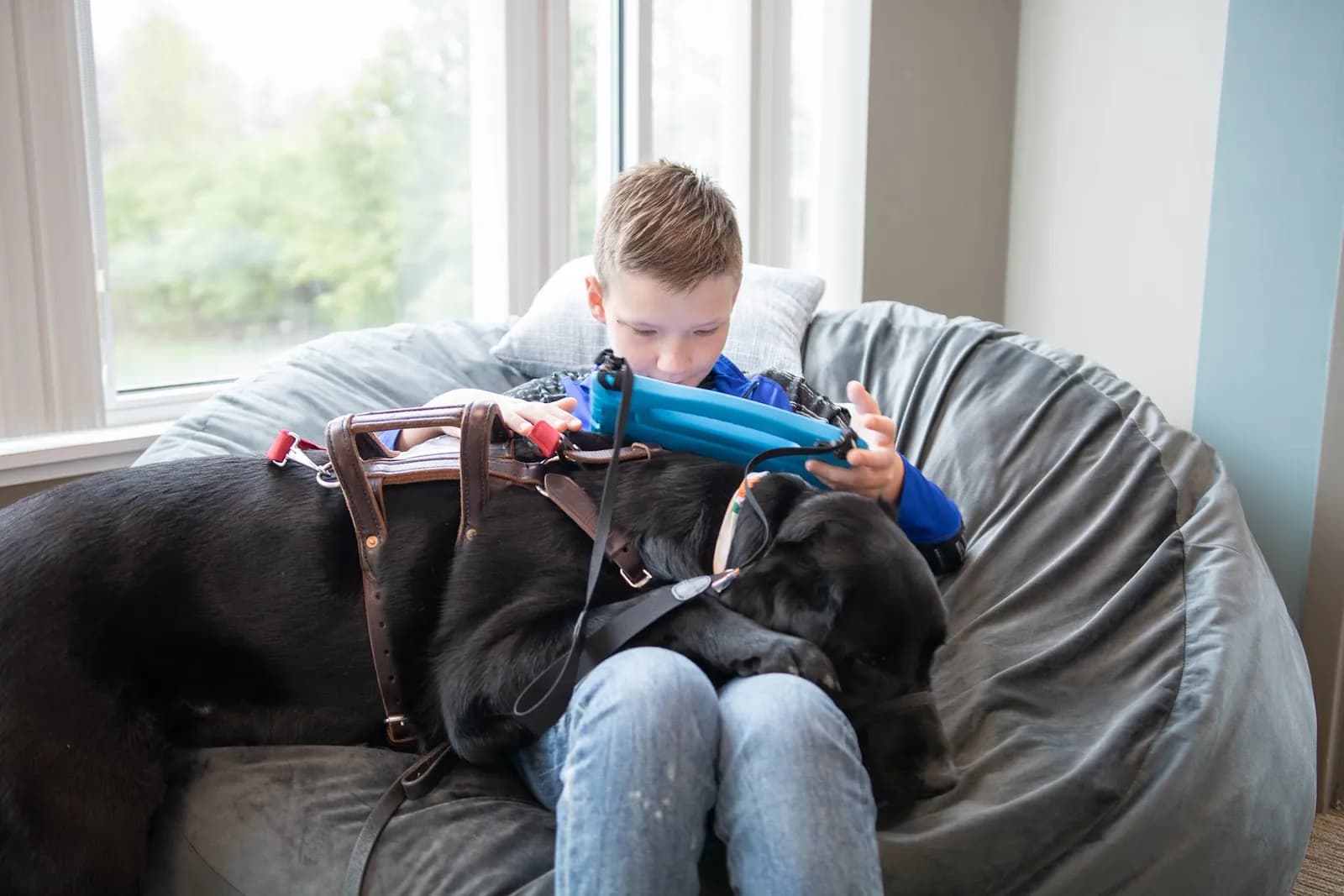
Children who use AAC learn to use their devices very similarly to how children who communicate by speaking learn to talk: by observing people around them communicating. This means that teachers, speech and language therapists and families need to become familiar with the child's AAC system and consistently model AAC use.
Modelling, sometimes called aided language stimulation, is the gold standard for teaching AAC to children with complex communication needs. It is simply allowing the child to see their conversation partners, such as parents, siblings, classmates, teachers and special needs assistants, using AAC to communicate in naturalistic settings, using either their own AAC system or borrowing the child's system. This demonstrates button locations, since many fringe vocabulary words are hidden in folders, and the intended purpose of the AAC system as a communication tool. Conversation partners often pair oral language with AAC as they model.
When introducing AAC, it is important to model during highly motivating activities. An approach that many therapists use is narrating a preferred activity, or narrating parallel play beside a child while modelling AAC. This allows the child to see AAC used to communicate during an enjoyable and motivating activity, even if they do not touch the device themselves.
You do not need to be perfectly fluent with the AAC system to model. Some familiarity with the system helps, but modelling self-correction, reflection and searching skills can also be valuable. As we continue to model AAC, our skills improve, just as children's skills do.
Modelling without expectations
Modelling is simply using a child's AAC system to show them how to operate the device, find words, and use it to communicate. There are parallels between introducing an AAC system and introducing a very young child to spoken language, and also with techniques used to teach a new language learner. A child with typical language skills and no Irish entering a Gaelscoil may take several years to become fully proficient in Irish, and is expected to develop strong receptive language skills before developing expressive language skills.
A new language learner is not expected to produce many utterances in their new language; early on, they are not even necessarily expected to understand much without support. Modifications for these students include using simple and clear language while still using correct grammar, using visuals and gestures, and modelling expectations. All of these techniques work for AAC users as well. And, much like new language learners, a child learning to use AAC should not be expected to quickly become proficient at using their device to communicate. We model communication without the expectation that the child copies our model, or responds to our question.
This can be much easier said than done. It is easy to slip into the pattern of asking questions and expecting an answer. However, the goal is to model communication in a way that is rich in language input but low in demands on the child. This helps them see communication as something that is rewarding, enjoyable and motivating, rather than hard or boring.
Nobody has to make a child use their device. Therapists call this modelling without expectations. Parents of very young children model language without expectations all the time: they ask their babies questions, talk about their plans, or narrate play with no expectation that their baby will answer. Children learn AAC the same way babies learn language, through consistent exposure. It takes a child without communication challenges several years to speak in full sentences, and AAC can take just as long to master.
Avoid quizzing a child, or demanding that they use their AAC to demonstrate knowledge. That is different from providing opportunities for communication. If you are offering a choice of blocks or cars, you can ask, model both choices on the device, and hold it out. If they point at the real toys instead, model their choice on the AAC system and give them the toy they chose. They do not need to use the AAC to make the request.
A total communication approach
Total communication means that any type of communication, such as speech, gestures, a tablet or a paper-based system, should be treated as valid. As communication partners for AAC users, we do not want to impose a certain modality on a child; we want them to communicate using whatever standard communication means they prefer. Standard communication simply refers to communication that a less familiar or unfamiliar listener can understand. While parents and educators may continue using Geabaire to model AAC use, children should be able to make requests or comments using any modality, or combination of modalities, they choose.
Here is an example of an AAC user combining spoken language and a high-tech communication device: Sam is a 10-year-old with diagnoses of autism and severe apraxia of speech. He wants to communicate using spoken language, but his ability to form words is heavily impacted by his apraxia. When he first attempts to communicate, he typically uses speech, and some of it is intelligible to a familiar listener. When his conversation partner does not understand him and asks him to use his AAC device, he uses it to fill in the gaps in conversation. An exchange may go like this:
Conversation partner: Who did you go to the pool with? I'm having a hard time understanding. Can you use your AAC to tell me?
Sam: [spoken] I go with [AAC] Mom, Aunt Tina, Andy. [spoken] Andy baby.
Conversation partner: Oh, Mom, Aunt Tina, and Andy! And Andy's a baby? Is he your cousin?
Sam: [nods; spoken] Yeah, cousin.
Sam uses his AAC and spoken language together. Without his AAC, he would experience significant frustration when communication partners only understood part of his message. A total communication approach that includes spoken language and AAC allows him to have richer and fuller conversations. Other AAC users may use their AAC differently, but children with spoken language may still benefit from a robust AAC system to address communication breakdown.
Early AAC use: what does it look like?
Early AAC users often use their devices in ways that do not immediately look like communication to the adults around them. They might press buttons randomly, or press the same button repeatedly, especially buttons that represent a favourite topic. This can pose a real challenge for parents, who might get tired of their child using their device to say "Dolphin! Orca! Blue whale!" over and over again.
It helps to reframe the purpose of this behaviour. Consider babies learning to speak: they start by babbling, making nonsense sounds, which eventually begins to sound more and more like words. When a child is pressing random buttons on their AAC device, they are learning how to make it say words. They are exploring language, much like how a neurotypical child babbles.
When a neurotypical child babbles "Dadadada", their parents often respond with something like, "Yes! Dada! There's Dada!" Whether the child is just babbling or intentionally requesting their dad does not matter; the adults respond as if the child was intentionally requesting, which strengthens the association between the sound and their dad. The same is true for children who use AAC. When possible, respond by validating your child's attempt at communication: if they are pressing buttons for vehicles, you might hand them the vehicle toy bin and say, "Here are the vehicles!"
Managing expectations and defining success
For many early AAC users, progress can seem quite slow, and steps towards goals can feel very small. Managing expectations and defining successes, for early AAC users and for their adults, is important. Recognising the small wins helps keep everyone engaged and motivated over the course of what can be quite a long process.
Neurotypical children take years to develop mastery of language, and neurodiverse children can take even longer. Learning to use AAC is also similar to learning to speak another language: the child has to convert their thoughts into icons, and use those icons to speak. It is normal for this process to take a long time.
Success varies for every AAC user, but the key factor is engagement. For some children, early engagement with their device might simply be looking at it; for others, it may be pressing random buttons. Watching conversation partners model AAC use is also a success: if a child watches and reacts when an adult models "It's time to go outside!", that is a communicative exchange, and that is a win.
Celebrate any attempt at communication and connection. If a child brings you a game or toy to play with them, that is a win. If they communicate that they want to watch Bluey, celebrate the request even if it is not reasonable at that time. You can say something like, “I’m so glad you told me that! We can watch Bluey after dinner!”
If a child chooses a different modality to communicate, that is worth celebrating too. Even after a week of modelling “up”, if they finally reach for the device and say “orange”, that is also worth celebrating. All communicative output is valid, and it deserves a response. Successes for early AAC users are often small, subtle steps towards connection and engagement, and what looks like a small success is a significant step.
Bilingualism and AAC
There is not a lot of research on bilingual AAC use, or AAC use in bilingual communities. The existing research (e.g. Salisbury-Ferguson et al. 2026) suggests that, even in bilingual communities, AAC tends to be monolingual, due to a variety of factors, including a monolingual mindset which holds that children with communication disabilities cannot be bilingual, or struggle more as a result of exposure to multiple languages.
There is a long-held belief that children with developmental delays and conditions that impact their language skills will struggle if they are exposed to more than one language. This has been proven untrue by several studies, which have shown that children with developmental conditions, including autism, Down syndrome and developmental language disorder (DLD), experience no negative outcomes from exposure to two languages. While their language skills may not match those of their neurotypical peers, these children are able to become competent bilingual communicators, though they may take longer to learn their second language, and may benefit from support from speech and language therapists in both languages.
There are limited studies on bilingualism and AAC specifically. However, several studies of bilingual children with a variety of communication challenges show that they are able to master code-switching, or switching between languages, in most of the same contexts as their neurotypical peers. This is important because code-switching is a complex task: it follows specific rules and requires an understanding of social contexts as well as knowledge of the grammatical rules of both languages.
Ponce-Lawler (2017) and Yu (2016) both conducted studies that included typically developing children and children with communication disabilities, and both found that bilingual children with communication disabilities perform similarly to their typically developing bilingual peers in using the pragmatic functions of code-switching. Yu (2016) found that the child in her case study, who has an autism diagnosis, was proficient in four of the five types of code-switching she identified; he was not observed using code-switching when quoting reported speech. However, Yu points out that this child struggled with quoting reported speech in any language, so this limitation was not specific to code-switching. The fact that children with communication disabilities are able to master code-switching in most of the same contexts as typically developing bilingual children suggests that their ability to learn and use two different languages is not inhibited by their developmental disability.
Bilingual children with developmental delays and conditions that impact their language skills also benefit from a strong model of spoken language from their caregivers. Which language this is does not matter; what is important for the child's language development is exposure to a variety of grammatically correct utterances in any language. A strong foundation in the language spoken at home provides a strong foundation for learning a second language. This is true for children with and without communication challenges.
Being able to communicate in both languages of their community is vital for children growing up in bilingual settings, whether they are attending a Gaelscoil or have family who live in a Gaeltacht. Because language choice can signal social belonging, an AAC user in a Gaelscoil, or with Irish-speaking family, needs access to communicative output in Irish to fully participate in these communities. While their communication challenges will persist across languages, AAC users who are members of bilingual communities are capable of, and have a right to, bilingual communication.
Building the team
Collaboration between families, teachers and speech and language therapists (SLTs) is vital to an AAC user’s success. Whichever of the three you are, keeping open lines with the other two is one of the most useful things you can do. This matters for a few reasons:
- It ensures access to appropriate vocabulary for school activities, extracurricular activities and activities of daily living.
- Caregivers, teachers and SLTs each interact with the child in different contexts, and each may be able to share different techniques and strategies to support the child in different settings.
- It supports modelling across settings.
Each part of the team holds different knowledge. Families are the experts on the child: their temperament, sensory needs, likes and dislikes, and how they communicate outside school. Teachers see how the child responds to demands and less preferred tasks, engages with instructional materials, socialises with peers and adults, and uses their device across the school day. SLTs support modelling at home and in the classroom, techniques for different environments, and using and customising the device.
Consent matters where an SLT works outside the school. A parent or guardian must give written consent before a school and an outside SLT can discuss a child, which protects the child’s confidentiality. The Parental Consent Form on the National Council for Special Education website has a section for this.
References
Bilingualism and communication challenges
- Durán, L. K., Hartzheim, D., Lund, E. M., Simonsmeier, V., & Kohlmeier, T. L. (2016). Bilingual and Home Language Interventions With Young Dual Language Learners: A Research Synthesis. Language, Speech, and Hearing Services in Schools, 47(4), 347-371.
- Kay-Raining Bird, E., Genesee, F., & Verhoeven, L. (2016). Bilingualism in children with developmental disorders: A narrative review. Journal of Communication Disorders, 63, 1-14.
- McNamara, E. (2018). Bilingualism, Augmentative and Alternative Communication, and Equity: Making a Case for People With Complex Communication Needs. Perspectives of the ASHA Special Interest Groups, 3(12), 138-145.
- Wagner, D. K. (2018). Building Augmentative Communication Skills in Homes Where English and Spanish Are Spoken: Perspectives of an Evaluator/Interventionist. Perspectives of the ASHA Special Interest Groups, 3(12), 172-185.
Code-switching and communication challenges
- Yu, B. (2016). Code-Switching as a Communicative Resource Within Routine, Bilingual Family Interactions for a Child on the Autism Spectrum. Perspectives of the ASHA Special Interest Groups, 1(14), 17-28.
- Ponce-Lawler, M. Y. (2017). The Use of Code-Switching in Bilingual Children With Autism Spectrum Disorder. Open Access Theses & Dissertations, 729.
- King, M. R., Romski, M., & Sevcik, R. A. (2020). Language Differentiation Using Augmentative and Alternative Communication: An Investigation of Spanish-English Bilingual Children With and Without Language Impairments. American Journal of Speech-Language Pathology, 1-16.
- Gutiérrez-Clellen, V. F., Simon-Cereijido, G., & Leone, A. E. (2009). Code-switching in bilingual children with specific language impairment. International Journal of Bilingualism, 13(1), 91-109.
AAC and speech development
- Millar, D. C., Light, J. C., & Schlosser, R. W. (2006). The impact of AAC intervention on the speech production of individuals with developmental disabilities: A research review. Journal of Speech, Language, and Hearing Research, 49(2), 248-264.
- Schlosser, R. W., & Wendt, O. (2008). Effects of augmentative and alternative communication intervention on speech production in children with autism: a systematic review. American Journal of Speech-Language Pathology, 17(3), 212-230.