How Geabaire works
The system contains almost 7,000 pre-programmed words and phrases, in addition to plurals and other grammatical forms generated automatically, enabling users to communicate both familiar and entirely original messages.
The Home board and core vocabulary
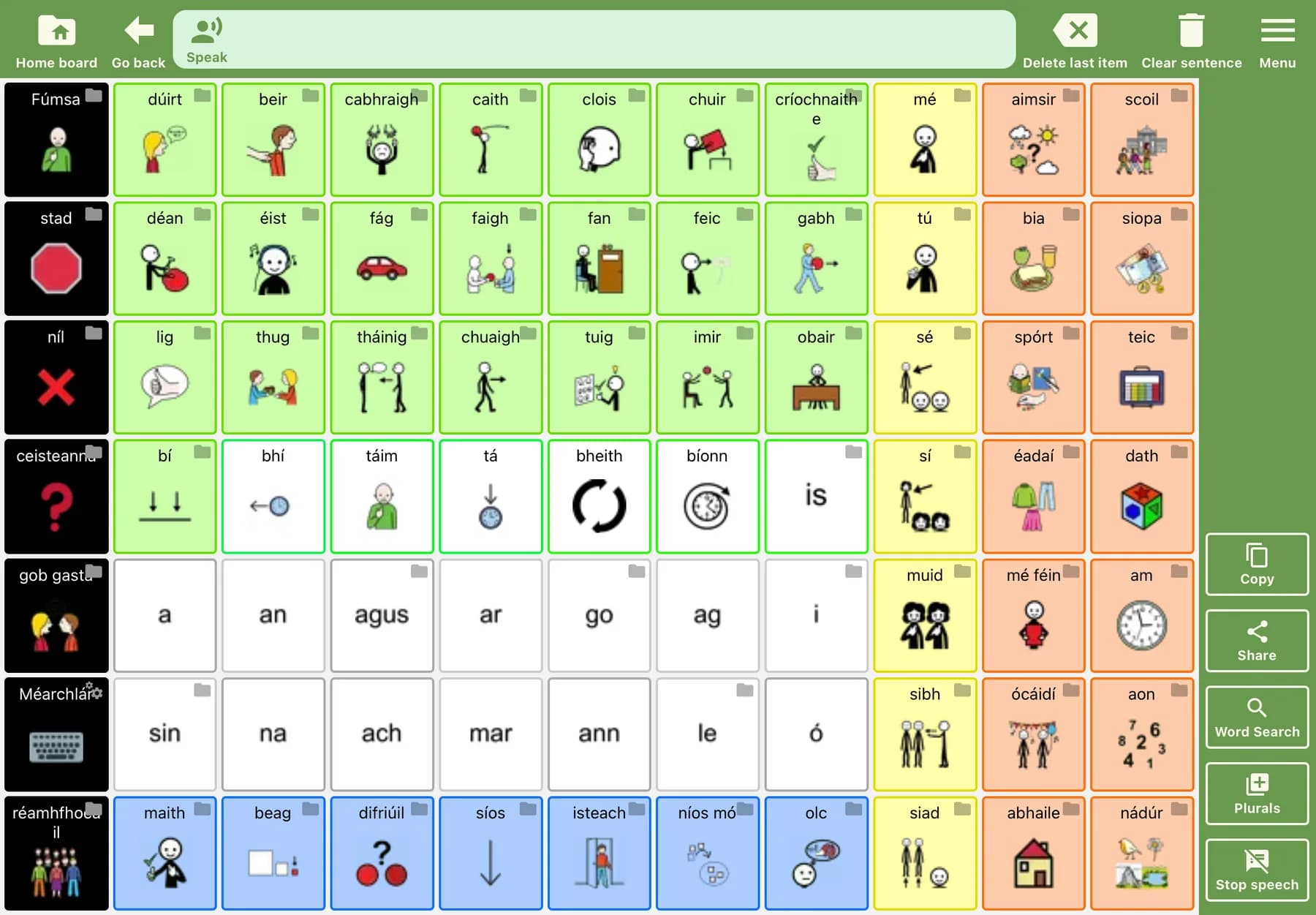
The Home board provides immediate access to the most frequently used Irish words, particularly verbs, pronouns and small grammatical words that can be combined across many different situations. It also gives direct access to important areas: Gob Gasta for quick phrases, Stad for self-advocacy and communication repair, Réamhfhocail for prepositional pronouns, Fúmsa for personal vocabulary, and the keyboard.
As no published Irish AAC core-word list exists, Geabaire’s core vocabulary was informed by An Ghaeilge Labhartha (Meascán Canúintí) in Liostaí Bhreacadh: Focail Choitianta sa Ghaeilge, a frequency list derived from spoken Irish across the three major dialects. Six of the ten most frequent words can be reached with a single selection, the remaining four within two selections, and most of the 100 most frequent words within two selections.
How vocabulary is organised
Words are displayed in a grid and organised according to part of speech, meaning, grammatical relationships, communicative function and motor-planning principles.
Simple statements in Irish generally follow verb-subject-object (VSO) order. Geabaire reflects this by placing verbs toward the left of the boards, followed by pronouns, nouns and other word types. This helps users move from left to right through the likely elements of an Irish sentence.
The colour key
Geabaire uses a modified Fitzgerald colour key to identify different parts of speech and highlight grammatical relationships. The same colours and word-type positions are used consistently across boards to support visual recognition and motor planning.
Conceptually related vocabulary is grouped on linked boards. For example, the siopa board contains shopping-related nouns, verbs and describing words. Most words remain in one consistent location, and vocabulary can generally be reached within one to three selections, supporting predictability, motor learning and efficient communication.
Grammatical support
Users select symbols or written words to construct a message. Each word appears in the sentence bar, where the complete message can be reviewed and spoken aloud using an ABAIR Irish-language voice.
Because Irish words can change according to their grammatical context, Geabaire uses automated language-processing tools to support sentence construction without requiring separate buttons for every possible form. These include An Gramadóir, the Irish grammar checker developed by Kevin Scannell, and additional grammar correctors including a genitive parser developed within ABAIR.
For example, the system should apply the required mutation to change mo teach to mo theach (my house). The genitive parser should also select the correct form in phrases such as doras an tí (the door of the house), changing teach to its genitive form, tí.
These features support more accurate sentence construction while reducing the number of selections required and avoiding overcrowded boards.
Verbs and verb forms
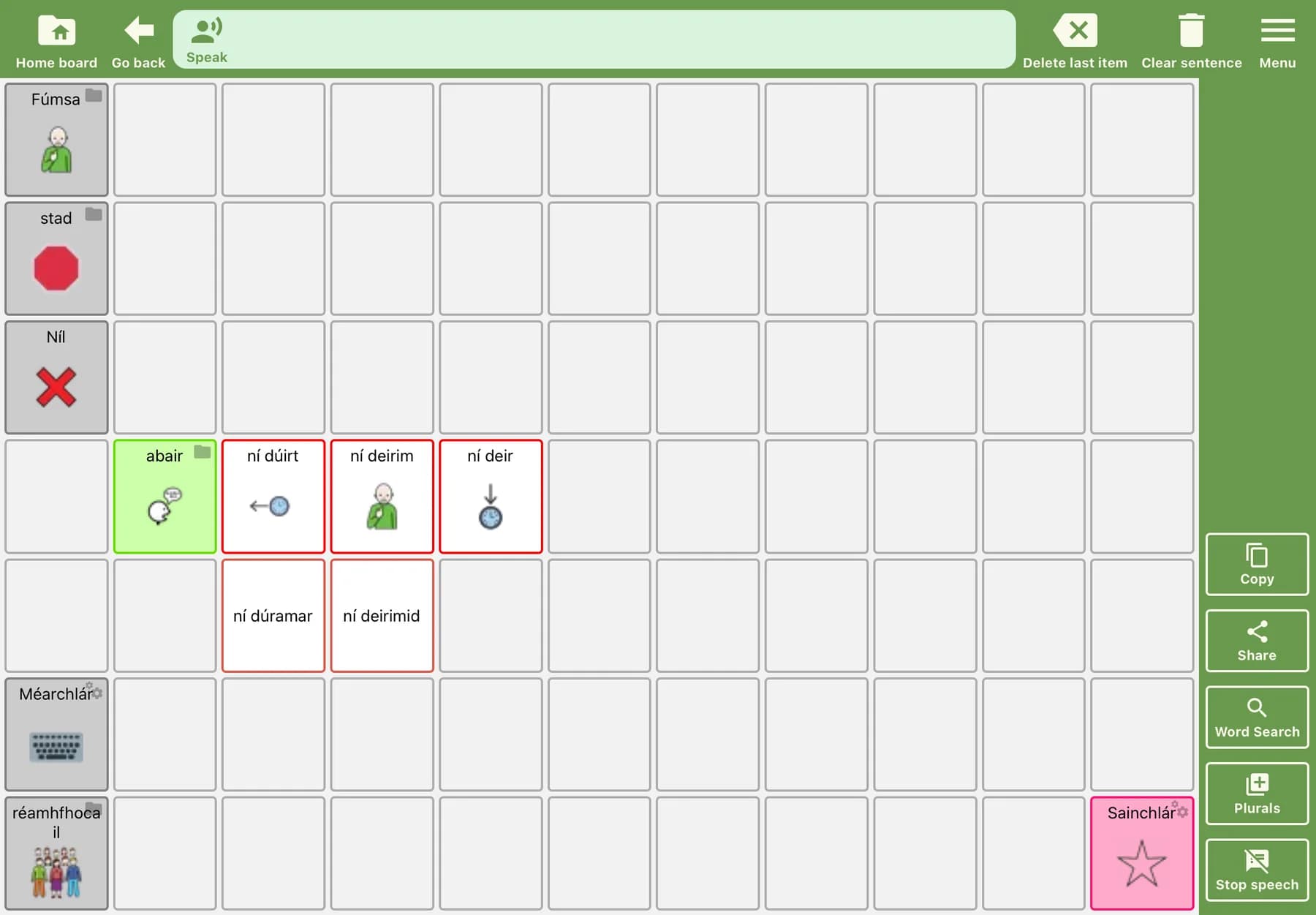
Geabaire provides access to a wide range of verb forms, including commands, past, present and future tenses, verbal nouns, infinitives, conditional forms and verbal adjectives. The forms appear in a consistent sequence and position, allowing users to develop predictable pathways to them. The verb root has a solid green background, while other tense forms have a green outline.
Questions and negatives
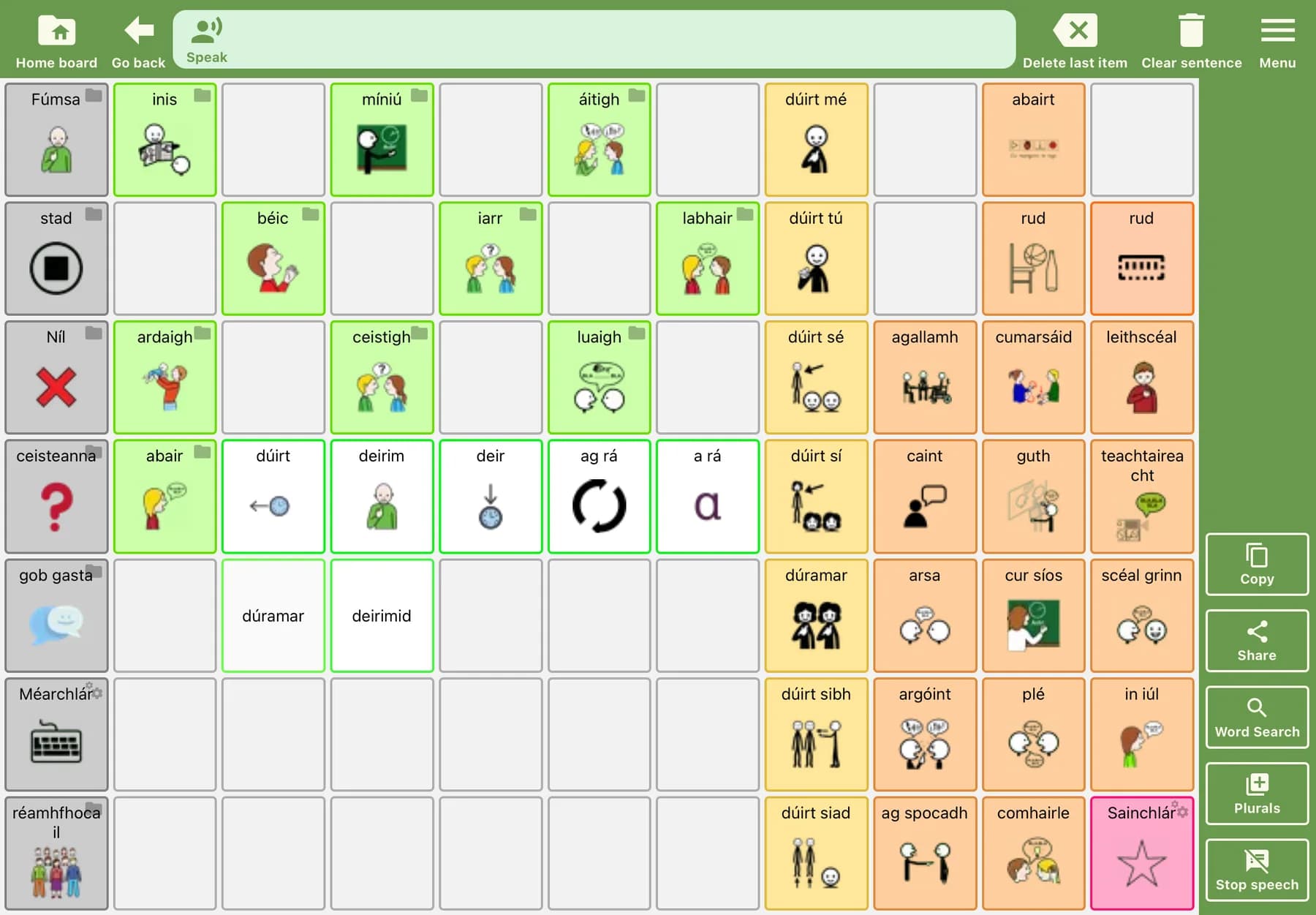
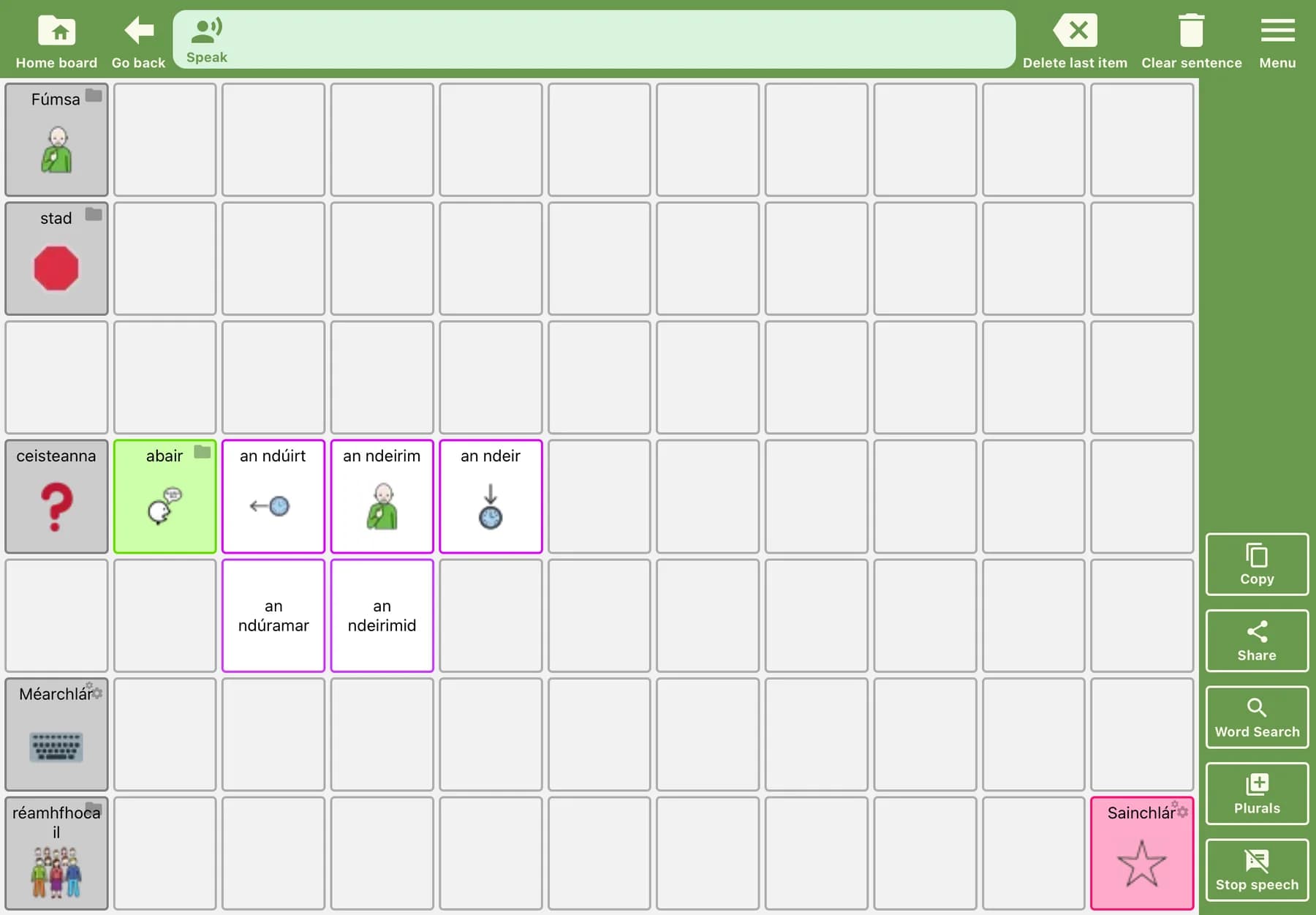
Irish does not have universal words corresponding directly to yes and no. A question is generally answered by repeating the appropriate positive or negative form of the verb. Geabaire therefore provides ready access to positive, question and negative verb forms.
Question forms are outlined in purple, negative forms in red, and the positive form is outlined in green. This makes the different forms easier to locate without overcrowding the main boards.
Plurals and prepositional pronouns
Irish plurals are often irregular and may involve internal changes to the noun rather than simply adding an ending. The Iolra button in the far right column generates the plural form of the noun previously selected, avoiding the need to display separate buttons for every singular and plural form.
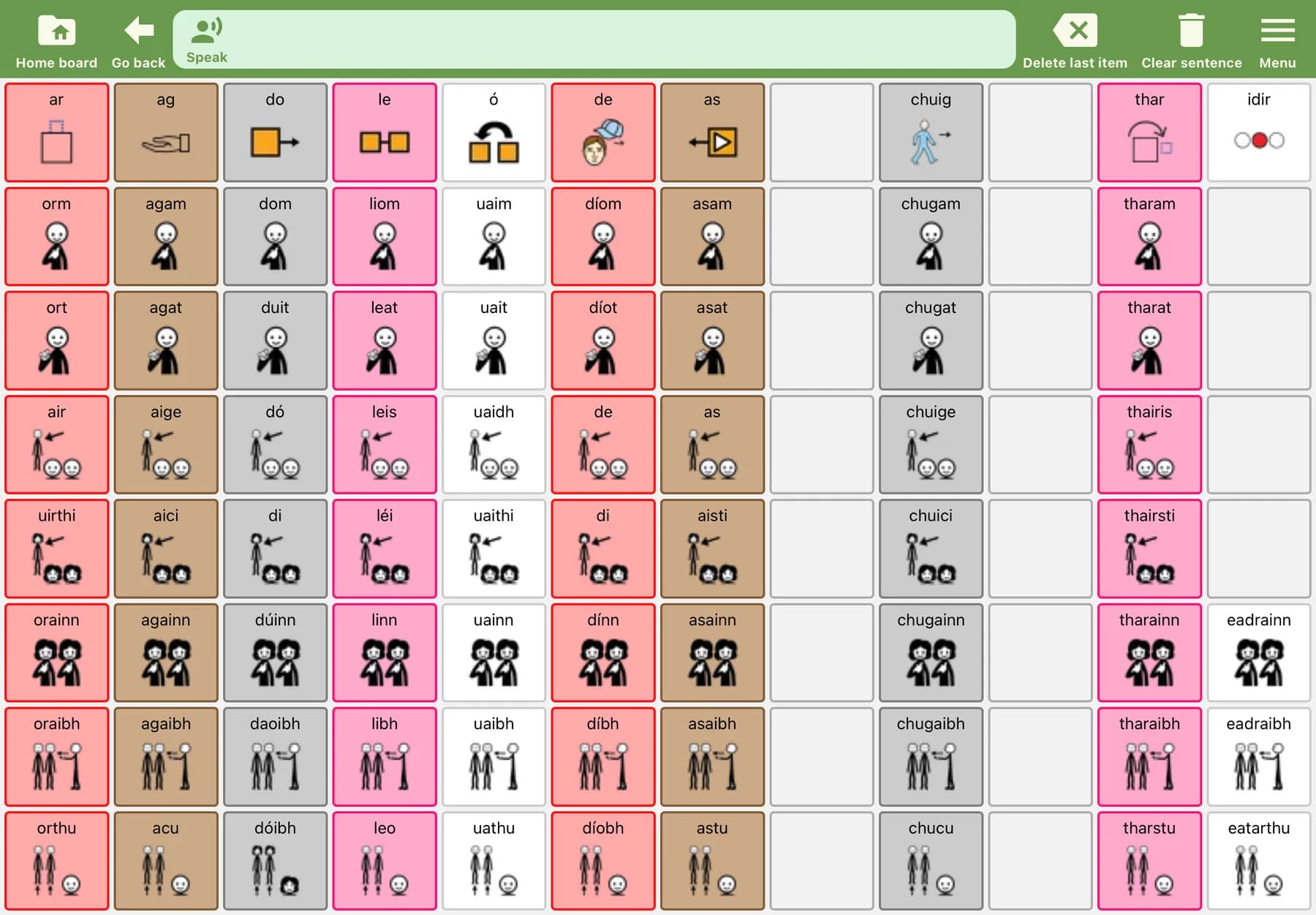
A Réamhfhocail button is available on nearly every board, giving quick access to commonly used prepositional pronouns such as liom, leat, agam and agat.
Gob Gasta: quick phrases
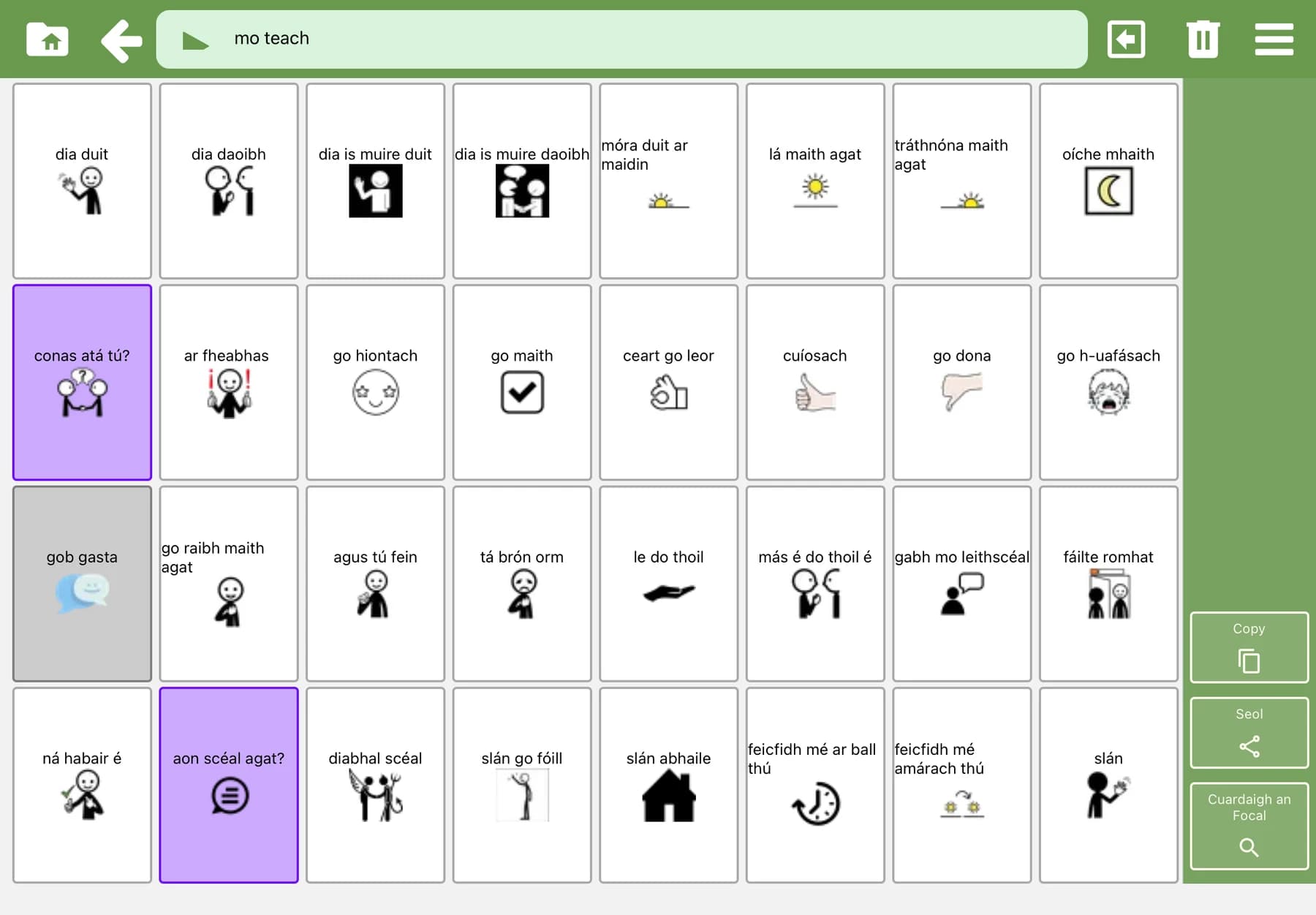
Gob Gasta provides immediate access to frequently used phrases that may take too long to construct word by word. The black Gob Gasta button on the Home board contains common greetings and responses. Grey Gob Gasta buttons on topic boards provide phrases connected with that theme, including conversational questions, classroom expressions, greetings, idioms, proverbs and similes.
Gob Gasta supports quick entry into conversations while the wider system remains available for creating original messages.
Stad: self-advocacy
Stad provides rapid access to important self-advocacy and communication-repair messages. These include asking for help or additional time, requesting a break, asking someone to stop, and explaining that something is wrong or that a message has not been understood.
The Stad button appears on every board so that this essential vocabulary remains immediately available, regardless of where the user is within the system.
Fúmsa: personal vocabulary
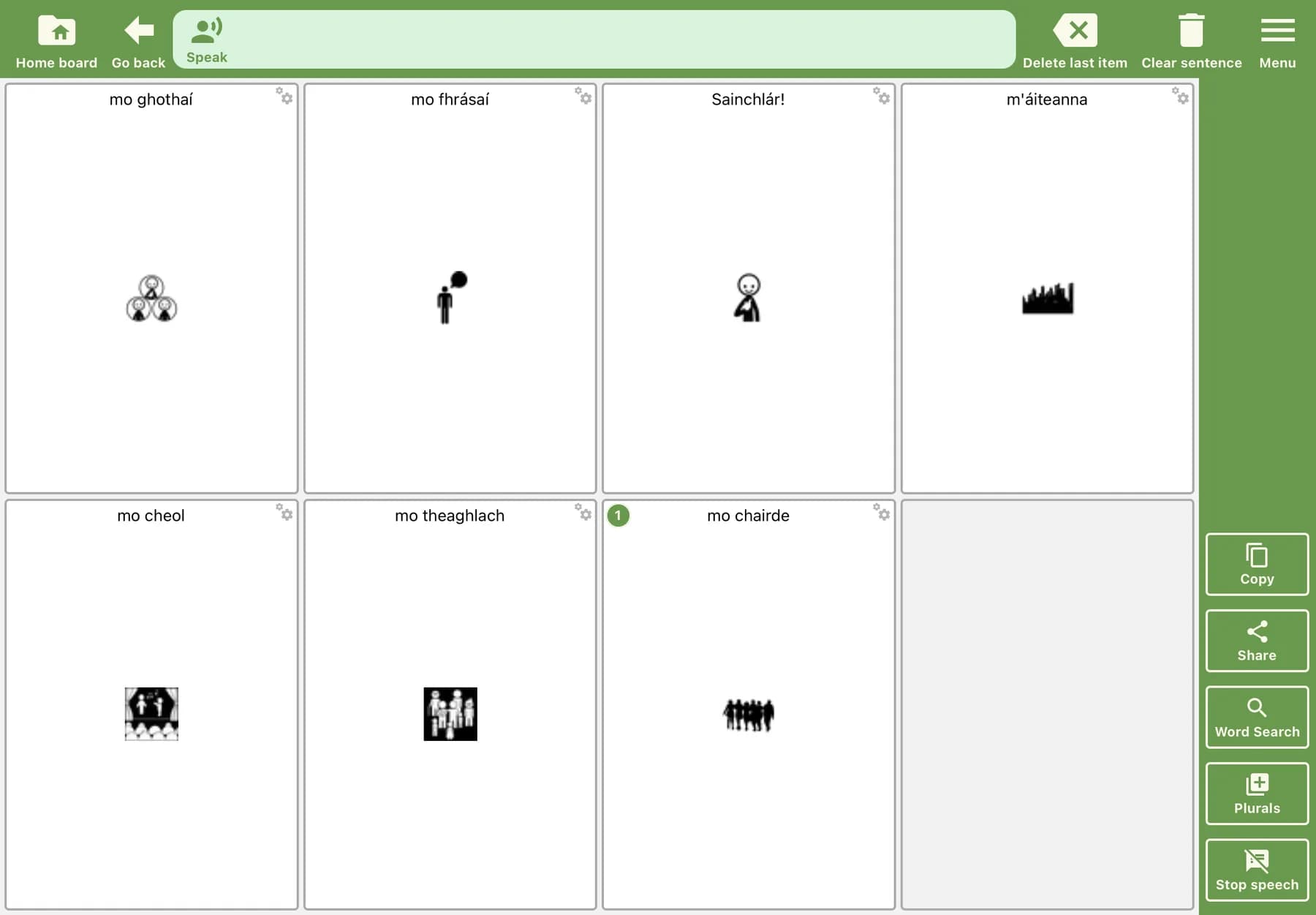
Fúmsa is Geabaire's main personalised area. It allows users to add vocabulary relating to their own lives, including family members, friends, important places, interests, activities and personally meaningful messages.
Personalised buttons can include ARASAAC symbols, photographs, written labels and individual speech output. This enables Geabaire to reflect each user's identity and experiences while maintaining access to the full vocabulary of the wider system.
Search and route-to-word support
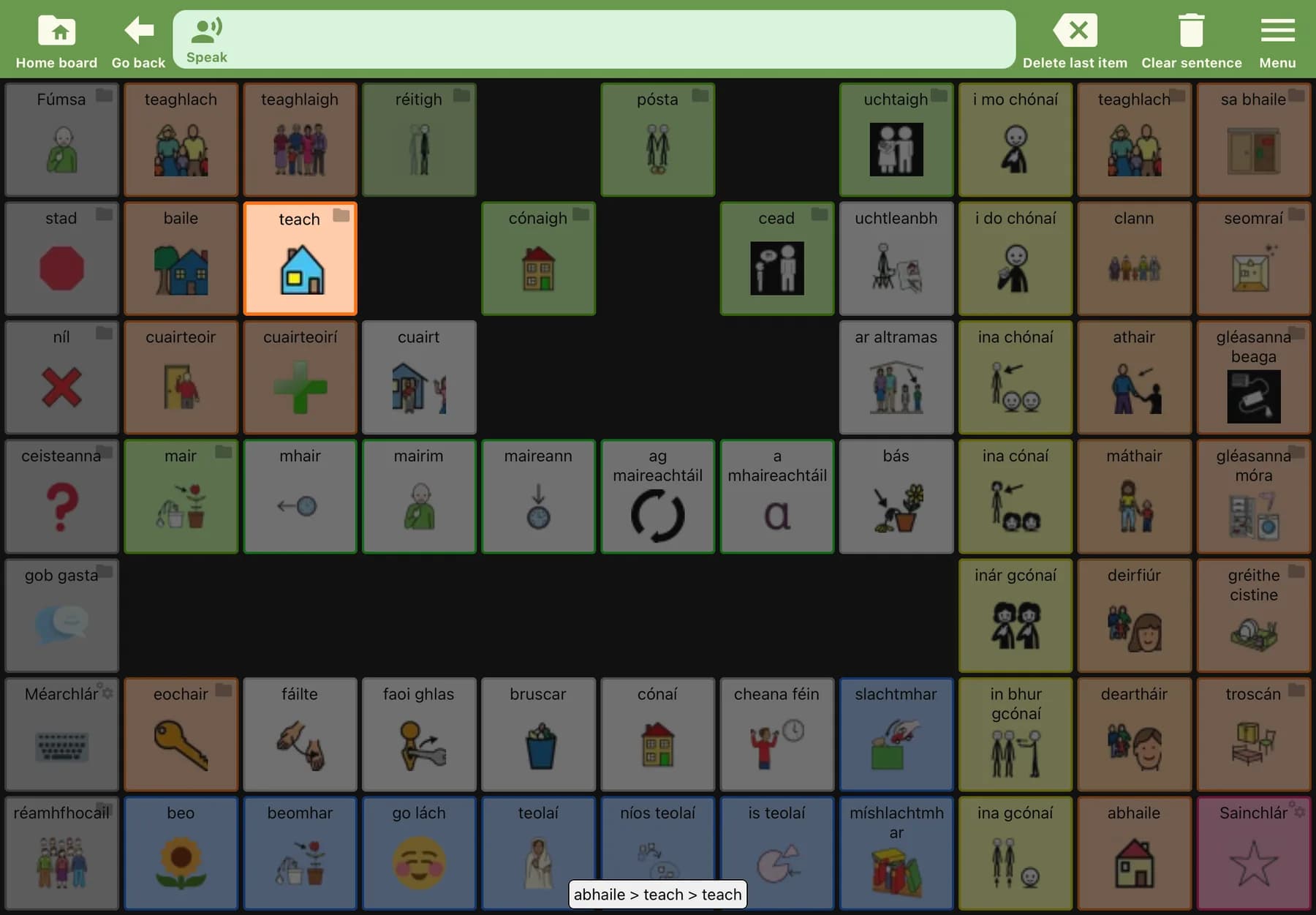
The search function helps users and communication partners locate vocabulary within Geabaire. When a word is selected from the search results, the system highlights the path showing the sequence of boards and buttons that leads to it, rather than simply inserting the word into the sentence bar.
The route taken through the boards is also displayed at the bottom of the screen. This supports users in learning where vocabulary is located and developing a consistent motor pathway to each word, reducing reliance on search over time.
The keyboard and Irish predictive text
The keyboard allows users to spell words and construct messages that are not pre-programmed within the symbol boards. This supports literacy, autonomy and the communication of entirely original ideas.
It includes letters, numbers, punctuation, Irish-language text-to-speech, support for Irish spelling and diacritics, word completion and next-word prediction. These features help users construct messages more quickly and efficiently while retaining full control over what they want to say.
ABAIR voices and dialect
Geabaire uses synthetic Irish-language voices developed by ABAIR in the Phonetics and Speech Laboratory at Trinity College Dublin. Irish has three main dialect regions: Connacht, Munster and Ulster. Each also has considerable regional variation, including varieties such as Mayo Irish within Connacht and An Rinn Irish within Munster.
Users can select their preferred dialect in the settings, choosing from voices representing the three main dialect regions. This allows the speech output to reflect the user’s language background, school community or preferred variety of Irish.
There are four versions of Geabaire to choose from: Clár Chonnacht, Clár na Mumhan, Clár Uladh, and An Clár Neodrach, the main board. Dialectal differences are reflected, with alternative words and phrases available where appropriate. This allows users to communicate in a dialect of Irish that is familiar and meaningful to them rather than being restricted to a single standardised variety.
For example, the phrase 'how are you?' varies by dialect: 'conas tánn tú / conas athánn tú' (Munster), 'caidé mar atá tú / cén dóigh atá ort?' (Ulster), and 'cén chaoi a bhfuil tú?' (Connacht).
An Clár Neodrach was included for learners of the language, so that the Irish of the dialect versions would not have to be limited for native speakers.
A wider selection of children's voices is also being recorded so that younger users can choose speech output that more closely reflects their age, identity and personal preferences.
Choosing a suitable board and voice
For a user with a connection to a Gaeltacht area, the choice of board usually follows the Irish of that area. For everyone else the question is more open. If a user is still learning the language, in a Gaelscoil for example, An Clár Neodrach usually suits them best, as the Irish on this board is based on the Irish taught in schools. If a user comes from a native-speaking background, we recommend a board that reflects the Irish used in their home or community.
There is no neutral spoken dialect, and no set voice that goes with An Clár Neodrach. When choosing a voice, we recommend that users without a connection to a Gaeltacht area choose the dialect of whoever uses AAC most with them, such as a teacher, SNA or conversation partner.
If you still have questions, it is worth discussing them with the user’s teacher or joining our support network, NEARTÚ.
About NEARTÚDialectal vocabulary will continue to be expanded and refined as Geabaire develops.
Editable and personalised boards
An edit button is available on every main board, allowing users and their communication partners to create a linked personal board. User-specific words, phrases, photographs and symbols can be added, ideally aligned with the theme of the board from which it is accessed. For example, a personal board linked to Bia might include the user's favourite foods.
Buttons cannot be added to, moved within, or removed from the main Geabaire boards. This preserves the system's internal logic, consistent navigation and motor-planning pathways, while ensuring users retain access to the full range of vocabulary.