
For teachers and SNAs
AAC for all students
Incorporating AAC into the classroom undoubtedly benefits AAC users: it not only helps them learn how to use AAC to communicate, but it normalises the use of AAC systems, supports comprehension by including visuals, and fosters connection between AAC users, their peers, and the adults who work with them. AAC users often have limited opportunities for peer interactions, and normalising the use of AAC in the classroom may afford them more opportunities to build relationships with peers.
Incorporating AAC into classroom routines also benefits the other children in the classroom. Particularly in the early years of school, neurodivergent and neurotypical children benefit from visuals, including visual schedules, choice boards and routine charts, to support their comprehension and retention of spoken instructions. Combining visuals with spoken language may also help children who have had limited exposure to Irish before entering Irish-medium education understand Irish in a more concrete way. Helping these children draw parallels between spoken words and the images on a visual schedule may help them grow their receptive vocabulary.
Using AAC in the classroom
The techniques below are not exhaustive, and teachers do not need to use every one exactly as presented. They are jumping-off points for figuring out what will work for you and your students. It is quite likely that you use some of these techniques already, and may only need a few minor tweaks to include the icons your students' AAC devices use.
Core and fringe vocabulary boards
Core and fringe AAC boards are printed AAC boards, much like those used for a light-tech AAC system. For classroom use, they may be printed larger for ease of use by multiple children at the same time. Adults can use these boards during instructional time to model for the group, and children can use them during less structured times to play and communicate with each other.
Some teachers make boards with removable icons velcroed onto the board, allowing students to remove icons and hand them to adults. This also allows adults to provide choices for activities: the adult can offer two or three icons for possible activities, and the child can choose one. Placed by the classroom door, it can also help manage transitions: when leaving, the teacher or assistant shows the class where they are going, and on return, what the next activity is. This type of board works for some classrooms, but adds moving parts for adults to keep track of, which can be a challenge.
It is particularly helpful to have boards with core and fringe vocabulary available and accessible for frequently used activities. For example, if you have a play kitchen in your classroom, you may want to have printouts of the AAC page for food and kitchen items laminated and attached to the kitchen play area.
Connection over compliance
Compliance is important in the school setting; children need to follow rules and expectations to learn. However, as teachers of early AAC users, we need to balance compliance with connection. Emotional connection with teachers and conversation partners is key to developing communication skills.
We want to make sure that young AAC users' early experiences with AAC are motivating and enjoyable. This may mean engaging in parallel play with children and narrating with the AAC device, or pushing the child on a swing while modelling "more" and "all done". Ensuring connection means being responsive to the child: to their wants, their interests, their communicative bids and their emotions. We need to model AAC use and try to make sure we are not constantly quizzing AAC users; engagement with their device should be self-motivated.
Children who use AAC should always have access to their device. This is not always practical: devices can break or lose their charge, and any AAC system can be left at home. However, those of us who work with children with complex communication needs are obligated to do what we can to ensure that they always have access to the most robust communication system possible. Even when students are using their devices in a way we may feel is inappropriate, pressing the same button over and over, using language inappropriate for school, or turning the volume up, they still have the right to communicate, and to communicate they need access to their AAC system. When speaking children use their voices inappropriately, teachers do not react by taping the child's mouth shut. Instead, they redirect or follow disciplinary protocols, even when it is challenging. Children with complex communication needs deserve the same.
Sample activities
These activities are not intended to be prescriptive; they are examples to give teachers and professionals working with students who use AAC ideas of how they might apply the concepts described above in their classrooms. All of these activities are meant to be done with significant adult involvement. The ability to complete independent work is important; however, these activities are intended to foster communication skills, which means adults need to be modelling AAC use throughout.
Arrival and dismissal routines
A visual schedule of the morning arrival and afternoon dismissal routines can be helpful, particularly at the beginning of the year as children are learning classroom routines. It can also help the adults in the classroom remember the routines and use consistent language. We all benefit from visuals!
- Find the icons you need to describe your morning routine, and take a screenshot.
- Paste the icons into a Word or Google document. This is tedious, but it works.
- Type or write a brief description of each step next to the icons; one to three words is good. This is not strictly necessary, but it can help all the adults use the same vocabulary every day.
Storybook activities
There are two main ways to approach storybook activities: the adult chooses the book, or the child chooses the book. Both are valid choices in different contexts. If there is a particular concept you want to work on, you can choose a book that targets that concept. If the goal is for the child to have an enjoyable experience reading a story with an adult, the child should choose the book.
Concept-driven storybook activities require some preparation, but are reusable and can be used fairly flexibly. An example based on the book Dialann Ainín Aimsire can be used to teach days of the week, weather, and the phrase chuaigh mé. Remember that this activity targets a concept or concepts; you do not have to narrate the entire book using AAC. Read as you usually would. If you use silly voices for different characters, keep doing that. If you often pause to ask questions, do that, and allow students to use AAC or spoken language to answer.
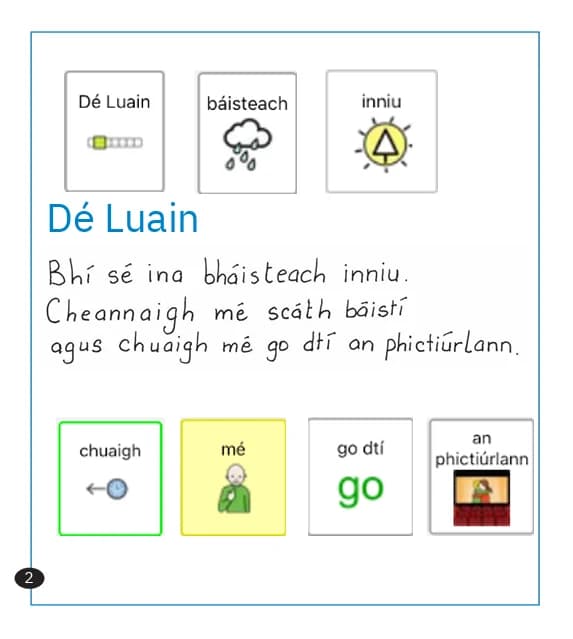
- Choose a story that features the concept you want to work on several times. Familiarise yourself with where these concepts are in the AAC system and, if you are working on multiple concepts, how to navigate between them.
- If you want, screenshot and print the icons and put them on the relevant pages in the book. This is not necessary, but it is nice to do.
- Model the concept as you read. If you are focusing on weather terms, model the term as it is used in the text.
- Model commenting on the text; this is really helpful and important. If you just read the page where it is snowing and modelled "Snow fell today", you can then comment "It snowed! She's cold" using the AAC.
Child-driven storybook activities typically do not require much preparation. You can still target language skills, but the main purpose is to have fun reading. This kind of activity is important because it establishes reading as a positive experience for children.
- Let the child choose a story. You may want to offer some choices that you know they enjoy if it seems like they are struggling to decide.
- Skim the book if you are not familiar with it. You can go in blind, but it is easier if you have an idea of what the story is about.
- Read the story as you normally would, incorporating AAC modelling where you can. If you are reading The Very Hungry Caterpillar, you might have the page for food displayed.
- Ask questions as you read, and give some wait time. If the child does not respond, you can model the answer using the device. You can also give the child opportunities to finish the sentence: "On Tuesday, he ate two..." and give the child the opportunity to say "pears!", or "But he was still..." "hungry!"
Themed scavenger hunt
Themed scavenger hunts can be a really fun way to get out of the classroom and use AAC in a wider variety of settings. They can also help children make connections between AAC icons and real items. Scavenger hunts are easiest with nouns, but you could include verbs and ask students to find something that does the verb. For example, you could have them find something that flies. They could look for a bug or a bird, and rather than bring it into the classroom, the child or adult could take a picture of it.
- Choose a theme, for example a nature scavenger hunt.
- Find the words you want to target on the device, and take a screenshot of the corresponding icons.
- Paste the icons into a Word or Google document, and include the text along with them. You may also want to include directions at the top of the page.
- Give the students the list of items to find, using printed words and the icons from their AAC device.
- Go look for the items. As you look, use the device to model: comment ("Oh, that's a beautiful flower!"), ask questions ("Where should we go next?"), narrate what you are doing ("I'm going to pick up this pebble and put it in our bag"), and give directions ("Please grab that leaf!").
Question of the week
This requires some involvement from adults at home, but is relatively low effort. It involves supporting the child to provide a brief answer to a fun question. It can be a good way to support all students as they build a classroom community as well as their communication skills.
- Come up with a question that all students in the class could answer with a brief answer, a few words to a few sentences. Ideas include: What is your favourite animal, and why do you like it? Did you go anywhere this weekend, or what did you do at home? What do you like to do when the weather is nice? Do you have a pet, and if not, do you want one? Try to avoid doing only favourite-thing questions; there is nothing wrong with them, but there are so many different types of questions to ask.
- On Thursday or Friday, send home a Question of the Week sheet with every child. The adults at home may need to support their child in answering the question.
- On Monday, every child, AAC users and non-AAC users, can have the opportunity to share their answer briefly with the class. Children who use AAC should always have the opportunity to answer independently, though they may need an adult to model for them after being given some wait time.
Concept sorting
This activity can be very helpful for introducing academic vocabulary as well as core and fringe vocabulary. It involves some printing and preparation, but can be reused as needed. Dialogue is a key part of this activity, so it is intended to be collaborative.
- Choose a concept to work on, for example farm animals.
- Print and laminate the farm animals icon from Geabaire twice, and also the NOT icon. Use these to make a sorting system: two columns, or icons attached to boxes.
- Decide if you want to use real items, toys or pictures. Gather some items that belong in the category you are working on, and some that do not.
- Mix the objects.
- Working with the child, sort the items into their column or box. It is important to talk with the child, and model on the AAC, about why each item goes where it goes. For example: "Oh, look, it's a cow! Granddad has cows on his farm. It goes in the farm box." "This is a television. That's not even an animal! It goes in the NOT farm animal box." "A lion! Roar! Where does he go? Lions are animals, but they belong on the savannah or at the zoo, not on a farm."
It is okay to model only the target vocabulary while working on an activity like this. It would be very challenging to use AAC exclusively, and multimodal communication, spoken language together with AAC, can help children develop expressive and receptive language skills.